
Volunteer Spotlight: Jose Luis Ortiz
Strengthening the bridge between Microsoft and medicine, Jose Luis Ortiz brings a tech leader’s perspective to UTSW
By Andrew Marton
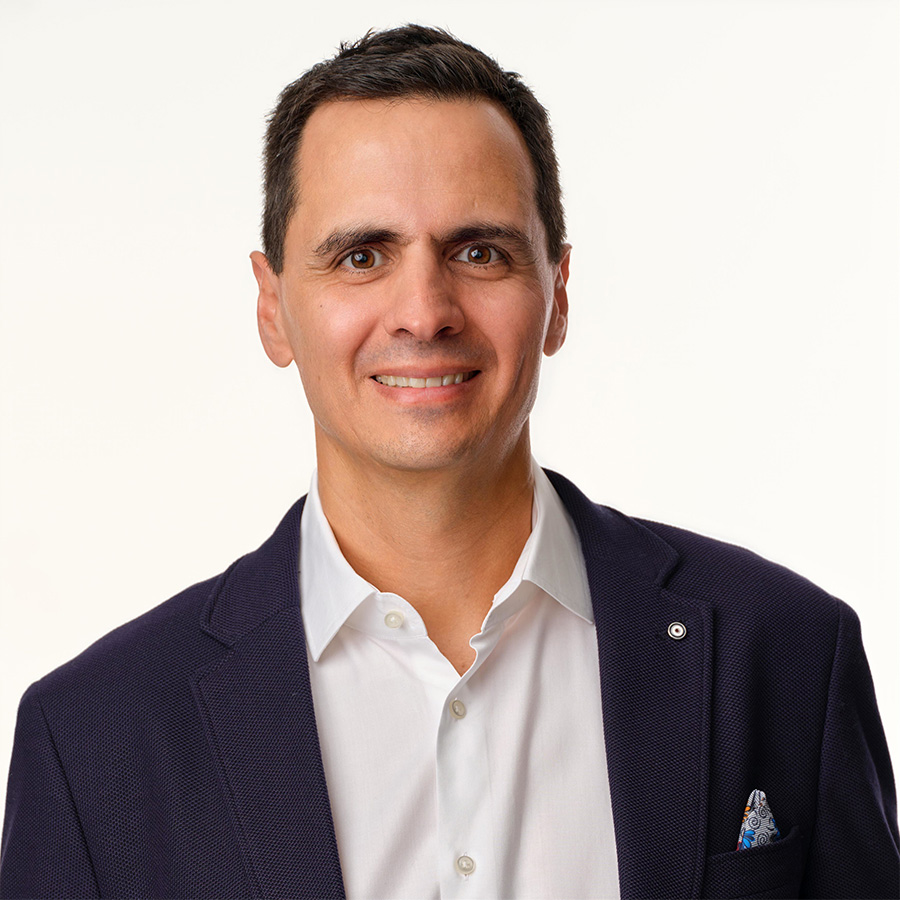
As one of Microsoft’s senior executives in Texas, Jose Luis Ortiz applies years of marketing and business experience to UT Southwestern Medical Center’s President’s Advisory Board (PAB), where he serves on the Executive Committee and chairs the Marketing Committee.
Mr. Ortiz is captivated by presentations from medical specialists, particularly those addressing advances in immunotherapies to fight cancer, and is working with UT Southwestern President Daniel K. Podolsky, M.D., to organize executive briefings bringing together high-level Microsoft researchers and innovators, including those involved in AI technologies and quantum computing, to explore ways to address some of health care’s thorniest challenges.
“I know we can co-innovate with UTSW,” Mr. Ortiz said. “It will be about advancing UTSW’s three-part mission of research, clinical care and education. By developing technologies together, we can better serve that mission. The goal is to build a strategic partnership that combines Microsoft’s capabilities with UTSW’s expertise to get the most from every solution.”
How does your experience inform your work on the President’s Advisory Board?
I have more than 30 years of experience in marketing, operations and sales at great companies like Procter & Gamble, PepsiCo and now Microsoft, and I have learned that it is really one craft. It is about listening carefully, earning trust and helping good ideas reach the people who need them.
UT Southwestern already does the most important work imaginable across its three-part mission of clinical care, research and education. What I try to contribute to the President’s Advisory Board is a business and marketing lens that complements that excellence. On the Marketing Committee, my experience building brands at scale helps the team find better, more human ways to connect with the Dallas-Fort Worth community. I also bring a deep understanding of the Hispanic community, which is such a vital and fast-growing part of our region.
What have you learned on the Marketing Committee?
Serving on the Marketing Committee has reminded me that even a world-class medical institution must earn attention and trust every single day, and that is a storytelling and engagement challenge as much as a scientific one. My focus has been on knowing precisely whom we are speaking to – whether patients, families, donors or referring physicians – and meeting each of them where they are with a modern, digital-first approach.
A wonderful first experience was the FIFA World Cup, for which UT Southwestern was an Official World Cup 2026 Dallas Host City Supporter. It gave us a chance to evaluate and refine how UT Southwestern shows up on a global stage and to sharpen the campaign so it reflected both the excellence and warmth of the institution.
What are some co-innovation areas where Microsoft and UT Southwestern can come together?
The most exciting part of this partnership is how naturally our missions align. UT Southwestern exists to prolong and improve life, and Microsoft exists to empower people through technology. I see co-innovation opportunities across all three parts of UT Southwestern’s mission. In clinical care, technology can give clinicians time back so they can focus on patients rather than paperwork. In research, modern AI and the cloud can help scientists analyze enormous and complex datasets and accelerate the path from discovery to treatment. In education – so central to UTSW’s mission – these same tools can enrich how the next generation of physicians and researchers learn, train and stay current in fields that are advancing faster than ever.
Where can AI make the biggest difference in research and clinical care?
The first is easing the burden on clinicians. Tools like Microsoft Dragon Copilot listen to the conversation between a physician and a patient and handle much of the documentation, which returns time and attention to care and helps address clinician burnout. The second is imaging and diagnostics, where AI can help specialists interpret scans more quickly and focus on what matters most. The third – and the one that excites me most for a research institution like UT Southwestern – is accelerating discovery. Microsoft recently introduced Microsoft Discovery, a platform that lets scientists work alongside AI to reason through research, generate and test hypotheses, and compress work that once took years into a matter of weeks.
What excites you most about the Innovation Hub?
What excites me most about the Innovation Hub is that it creates a dedicated place to turn bold ideas into proven practice. It is a natural home for co-innovation – a space to pilot new technology responsibly, measure what works and then scale it across the institution. The same opportunity extends to the New Pediatric Campus and the planned expansion in Fort Worth. Each is a chance to design care and discovery around the patient from the very beginning, with modern technology built in rather than added later. For the growing Dallas-Fort Worth community, that means world-class medicine closer to home. If we get this right, technology quietly does the heavy lifting in the background so that UT Southwestern’s people can do what only they can do: heal, discover, and educate.
- Dr. Podolsky holds the Philip O’Bryan Montgomery, Jr., M.D. Distinguished Presidential Chair in Academic Administration and the Charles Cameron Sprague Distinguished Chair in Biomedical Science.